Table of Contents
Conducting market research is important for you to find decision-influencing information for your business plan. We typically think of market research as being done by big corporations with big budgets and complicated processes. As a small Canadian farm, food, or drink business owner, you can adapt your research approaches to be simpler and less costly.
As a starting point, let’s look at different research methods, and then how to approach a target market research project.
Research Approaches
In the corporate world, companies pay for substantial reports, or spend money on extensive surveys and focus groups. You probably don’t have those resources, so here’s how you can approach your own market research needs as a Canadian farm, food, or drink business owner.
SECONDARY RESEARCH
Where you start is with something called Secondary Market Research (second-hand information). This is when data is gathered through existing information sources such as reports, articles, or surveys conducted by other businesses and organizations, or even research previously conducted by your own business.
This is generally a recommended first step in the research process as it allows you to carry out a high-level exploration in a quick and economical way. This initial study can sometimes reveal information that is key to inform decision-making, however even if it’s not conclusive it still lays the groundwork for further research.
Despite the benefits, the data gathered through secondary research is not specific to your current business needs or situation. In order to maximize the value of secondary research it’s important to focus on information that directly relates to your research objectives.
Examples of Secondary Market Research Sources in Canada:
Competitor Websites
It helps to analyse your competitors, or who you think are your competitors. Study their branding, messaging, packaging, pricing, and distribution channels. Pick up on key words that might fit your brand – e.g., natural ingredients, kid-friendly, immune booster. Look for gaps or opportunities in the Canadian food and drink market that you can leverage.
PRIMARY RESEARCH
A way to validate or quantify the insights from your Secondary Research is to conduct Primary Research. For example, if research reveals that there is a demand for local and organic, you may need to validate it through interviews in primary research, or quantify it through a mass survey.
Sometimes the most effective way to get information is to just ask people directly, or observe their activities.
For example, if you sell at a farmers’ market (or are about to), ask people for their input. Have some specific questions ready that are easy to answer, and easy to analyse. The same goes in retail situations, engage people who are interacting with your product. Find out more about them and their buying habits.
Sometimes you can be influenced by family and friends. That’s okay, but your circle knows, likes, and trusts you, so may say anything to support you. Take the perceptions you get from them and then take it to the consumer to fully test these ideas.
Social media listening and digital analytics are also ways you can observe who is engaging with your brand. In early stages of your business this will be slow, but as you grow your business you will see data than can help you make decisions to work with your target audience.
Target Market Exercise
Research should happen not only at the concept stage of your food business, but as an ongoing commitment as your company grows. You will have different objectives for each research initiative and that will drive what information you’re looking for or hoping to find.
Example: Following is some guidance for defining your target audience. You can research different aspects of the criteria and often determine how they co-relate to each other.
1. Why Identify a Target Market?
Having a clear understanding of your target market is essential for effectively marketing your Canadian farm, food, or drink product. It helps you optimise your marketing efforts, tailor your messaging, improve your food product, gain a competitive advantage, and achieve a better return on investment.
Knowing who is more likely to buy your product helps you be more intentional with everything in your marketing to attract your people.
Research can help you do that.
2. Understand Your Product
Although you may have some inklings of who your market is while you develop your product, get even clearer on what you’re offering so you can connect more deeply with your consumer.
Let’s start with what makes your product appealing. What is a key feature; what is the benefit of that feature; and who does it benefit?
An example:
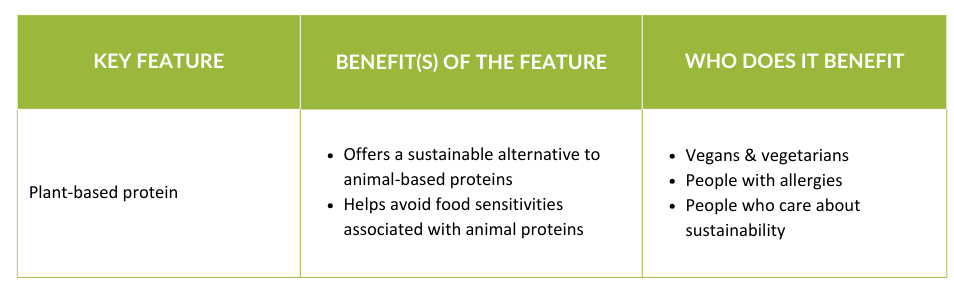
Using that information can point you to even more fine tuning to really understand your target market, and why and where they buy.
3. Create Target Market Profile(s)
Depending on your food product(s), you may have more than one target market – e.g., a different one for each product. You won’t find all the following information in the same place at the same time, but you can gather it and build your target profiles as you learn more. There will be some data that you need to research.
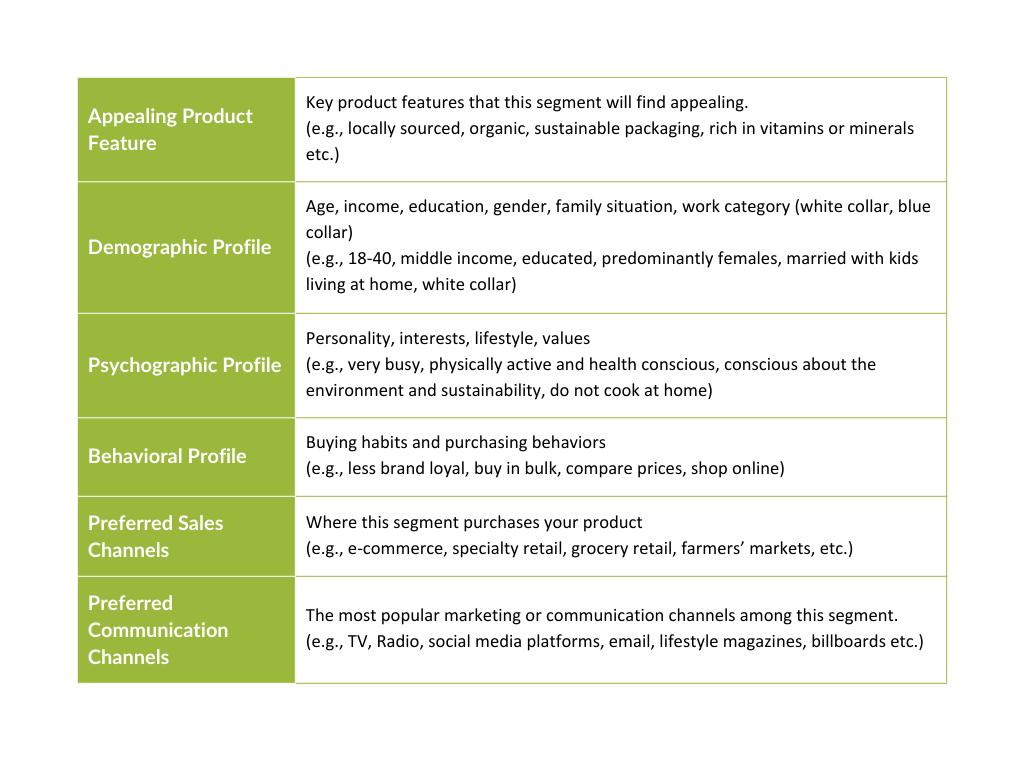
Depending on your business model and product line, you may have more than one target market segment. Go through the same exercise to create additional profiles, with a different research project for each one.
This information will help you direct your messaging to these different audiences. For example, you may have a product that you could sell to stay-at-home moms, but also to university students living on campus. Your marketing mix and messaging would be different for each of these segments.
That’s why it’s so important to understand your target market. It may even affect how you could improve your product or develop new ones.
Support For Your Research Project
Unless you’re knowledgeable about the food industry, a research project may not be as effective if done in isolation. Farm Food Drink offers guidance, direction, and support on how to create a practical research plan and how to right-size your project, so it’s not overwhelming. We can then review your research results and provide recommendations for further action.
Whether you’re looking to zero in on your target market, determine best sales channels, study packaging options, or other food business essentials, please contact us to discuss your research project. Let’s get you dialed in.
If you’re a good person doing good things with food, we want to hear from you!
Do you have a story to share or a project you’re interested in?
Get In Touch