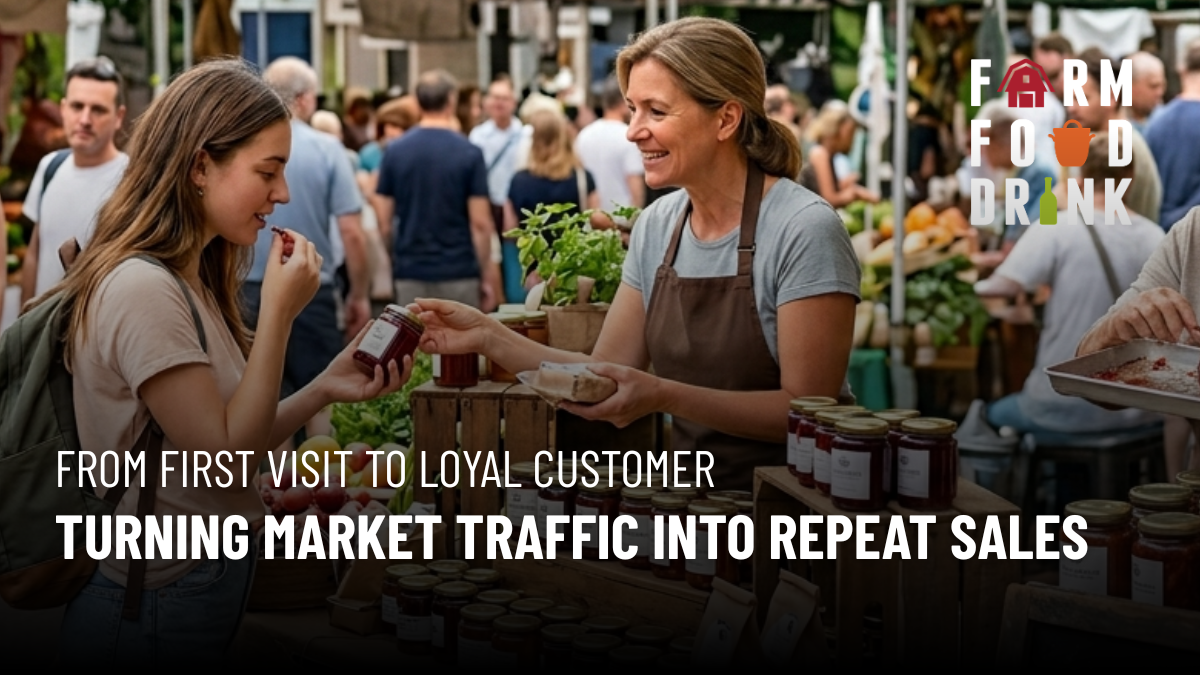
Markets are good at generating first-time customers. They bring in foot traffic, create opportunities for discovery, and give people a low-barrier way to try something new.
What they don’t guarantee is what happens next.
For many food and beverage businesses, market days result in strong one-time sales but can have little carryover. Customers buy once, enjoy the product, and then disappear.
Not because they didn’t like it, but because there was no clear path to come back.
A sale isn’t the same as a customer
It’s easy to treat a purchase as the end of the interaction. But in a market setting, it’s usually the beginning, or at least, it should be.
A customer who buys from you once has already:
- shown interest
- trusted your product enough to try it
- spent money
That’s a higher-value interaction than most digital touchpoints. If nothing carries that forward, no reminder, no follow-up, no reason to reconnect, the relationship ends at the transaction.
Where the drop-off happens
The gap between first purchase and repeat customer is rarely about product quality, but a lack of structure.
Common issues can include:
- No visible brand name or handle to remember later
- No prompt to follow, join, or reconnect
- No system for capturing contact information
- Packaging that doesn’t lead anywhere
- No reason given to come back
From the customer’s perspective, the interaction is complete. From the business’s perspective, an opportunity was missed.
What to build into your booth (beyond the sale)
Turning a one-time buyer into a repeat customer doesn’t require a complicated system, but it does require intention.
A few simple touch points make a measurable difference:
A Clear Digital Connection Point
This can be a QR code, but it needs to lead somewhere specific, not just a homepage.
Examples:
- a newsletter signup with a clear benefit
- a “find us again” page with stockists or market dates
- a simple landing page with your product range
If the destination isn’t clear, the scan won’t happen.
A Reason to Engage Now (Not Later)
“Follow us” on its own is often not enough. Customers are more likely to engage when there’s a defined value:
- entry into a small giveaway
- access to a recipe, offer, or early product drop
- a clear incentive tied to joining your list
The key is immediacy. If it feels optional, it gets skipped.
Packaging That Continues the Interaction
Once a customer leaves your booth, your packaging becomes your main communication tool. At minimum, it should:
- clearly show your brand name
- include your handle or website
- make it easy to find you again
Without that, even satisfied customers may not remember how to return.
Note: If you can't or don't currently have packaging that can continue this interaction, you could use a business card, rack card, recipe card, or something similar to give away with the product.
A Simple Follow-Up System
If you’re collecting emails or building a list, what happens next matters. A basic structure is enough:
- a short welcome email
- a reminder of what they purchased
- where to find you next or how to reorder
This doesn’t need to be complex, but it should exist.
What this looks like in practice
A common example we see working well:
A customer approaches a booth, samples a product, and makes a purchase. At checkout, there’s a small sign:
"Scan to enter this week's market giveaway"
The QR code leads to a simple landing page:
- name + email entry
- a clear incentive (e.g. win a $25 bundle or next market credit)
After entering, they receive:
- a short welcome email
- a reminder of the product they tried
- a note on where to find the business next
Results
- the business captures contact information
- the customer has a reason to reconnect
- the interaction extends beyond the market
Repeat customers are built, not assumed
Markets create visibility. But visibility on its own doesn’t build a customer base. Without a way to reconnect, each market becomes a reset: new people, new conversations, new sales, but no accumulation.
When simple systems are in place, that changes.
- Customers recognize your name.
- They look for you.
- They return intentionally.
A strong market day isn’t just about how much you sell. It’s about how many people you give a reason and a way to come back.
Because over time, the businesses that grow aren’t just the ones making sales. They’re the ones building relationships beyond the table.